

This is the written version of a talk I gave at Founders Forum last week.
Life is weird in 2026.
I’ve spent 15 years building startup programs in 50 countries, and the ground has never shifted this fast. My argument is that we’re entering the second major wave of entrepreneurship this century. And it’s a fundamentally different kind of wave than the first. What worked in the first wave won’t work for what’s coming. Three things will: community, allocation, and discernment.
Wave One: The Gold Rush (2008)
The first wave was around 2008. For a long time, if you called yourself an entrepreneur, that was code for “you sleep on the couch in your mom’s basement and you can’t get a job.” If you told a good-looking person at a bar that you were an entrepreneur, they would not give you their phone number. 2008 was when that began to change.
Cities started branding themselves as startup hubs. Austin’s brand became tied to startups. We got celebrity entrepreneurs. Shark Tank became a thing, Mark Cuban became a media personality. The internet was coming online, cultural patterns were shifting, and pursuing entrepreneurship no longer meant you were completely desperate with no other option.
I was at the very beginning of that wave. I’d built two tech products that failed, but when I went to grad school at the University of Texas, I was horrified when I found out a professor teaching entrepreneurship had never started a business.
I felt like I knew more from the failures of starting my own. I met other founders who felt the same way, and we started running programs based on what we thought truly mattered: getting people in a room and having them learn by doing. That became 3 Day Startup, a company we took from Austin to 50 countries over the next 10 years. We helped entrepreneurs get started in all kinds of places. New York, Miami, Silicon Valley. But also Seoul, the rainforest of Brazil, and the outback of Australia.
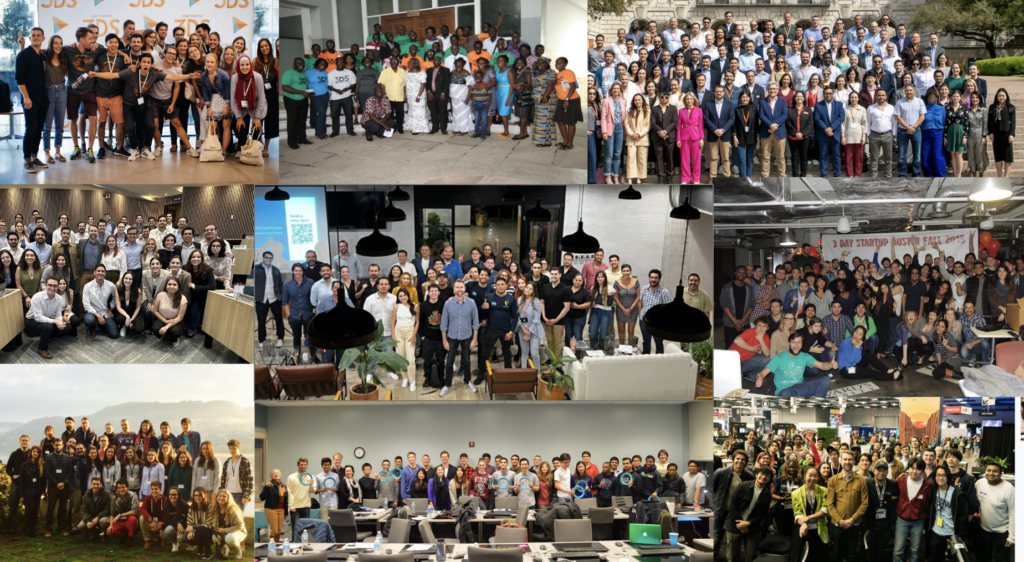
The way to think about this first wave is that it was a gold rush.
Life was fine, and people chose to start businesses because the opportunity looked exciting. “We understand the risk, let’s go try out this new thing.” And like any gold rush, some people got rich and a lot of people didn’t.
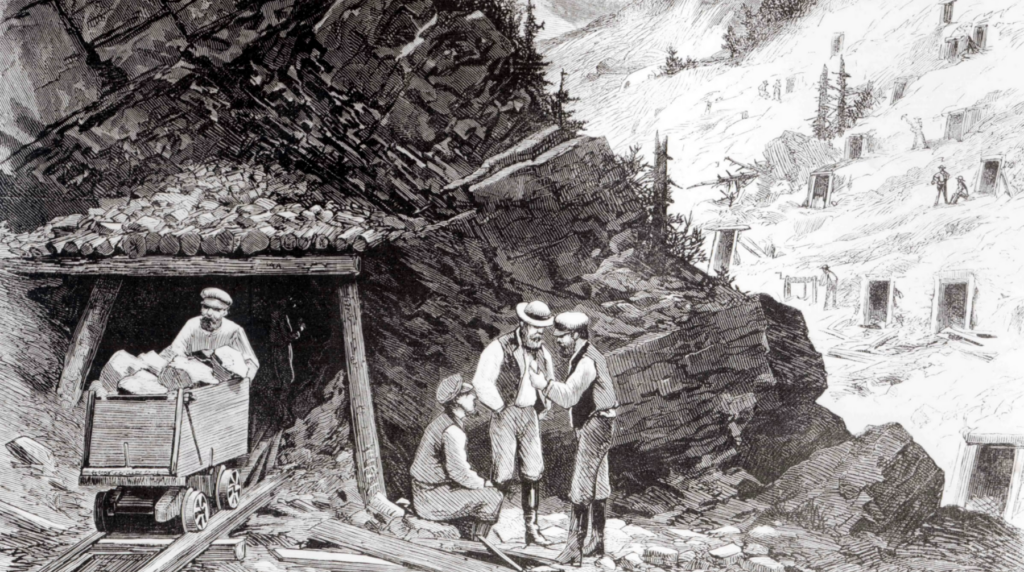
What mattered in the first wave was talent and capital.
Talent is important in any era of entrepreneurship, but in this one, what mattered was the breadth of it. If you wanted to start a tech company, you needed a designer and a developer. If you were about to close your first enterprise deal, you needed a lawyer for create a contract for you. A lot of people were involved in getting a business off the ground, and you had to have them.
Capital mattered because starting a business was expensive. Remote work wasn’t yet a thing, so companies needed an office. Add in incorporation, legal fees, and hiring, and there was a lot of money required just to get going. The barriers to entry were real.
Wave Two: The Tsunami (Now)
The second wave is starting now. We are going to enter the biggest era of entrepreneurship we’ve been in in quite a while, and it’s a different kind of wave.
If the first one was a gold rush: “there’s something cool in the distance, let’s go explore that.” This one is more like a tsunami. This one is happening to us.

I’m talking, of course, about AI. Regardless of our feelings about it, it’s here to stay. OpenAI and the other major AI companies haven’t proven they’re going to make enough money to justify their valuations, but it doesn’t matter. Even if the development of frontier models stopped today, the world is already in a different place. In the first wave, you chose entrepreneurship. In this one, it’s happening to you.
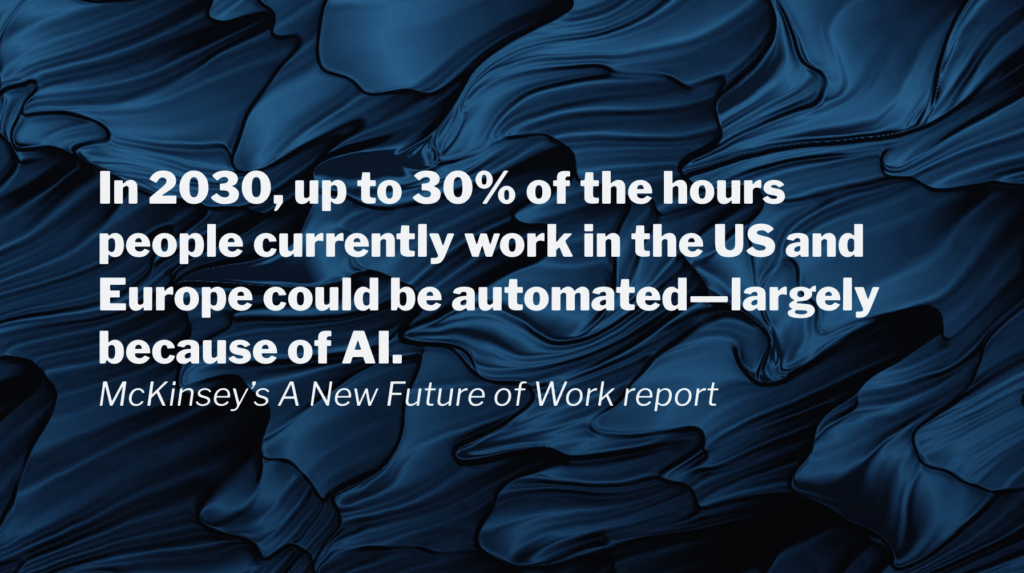
McKinsey’s A New Future of Work report puts it starkly: “In 2030, up to 30% of the hours people currently work in the U.S. and Europe could be automated—largely because of AI.”
Two weeks ago, Jack Dorsey (founder of Twitter, now running a company called Block with 10,000 people) put out one of those company announcements about letting people go. In an era of really poorly written versions of these, his was at least direct: “This sucks. We want to do the hard thing now rather than later.” The thing he attributed it to was AI.
We’re hearing more and more of these stories. Klarna let go of a ton of people, then two months later said “Oops, we were stupid” and hired a bunch back. I think that’s the exception rather than the rule.
What Matters Now
1. Community
Community has never not been important, but its role in the success of founders is only going to rise.
If you have a day job and your boss makes you want to run into a brick wall, it’s very easy to find people who relate. An annoying boss is common. But if you’re an entrepreneur and customers aren’t buying what you’re selling, or you’re trying to raise capital, it’s much harder to find people who understand those challenges. And it’s just nice to not feel alone in it.
This is what drove me and Adriana Cruz at the Round Rock Chamber of Commerce to build Jumpstart, a free, equity-free entrepreneurship program we ran last month. It’s not a lecture series or a networking event. The whole point is action (there’s a reason I named my company Actionworks).
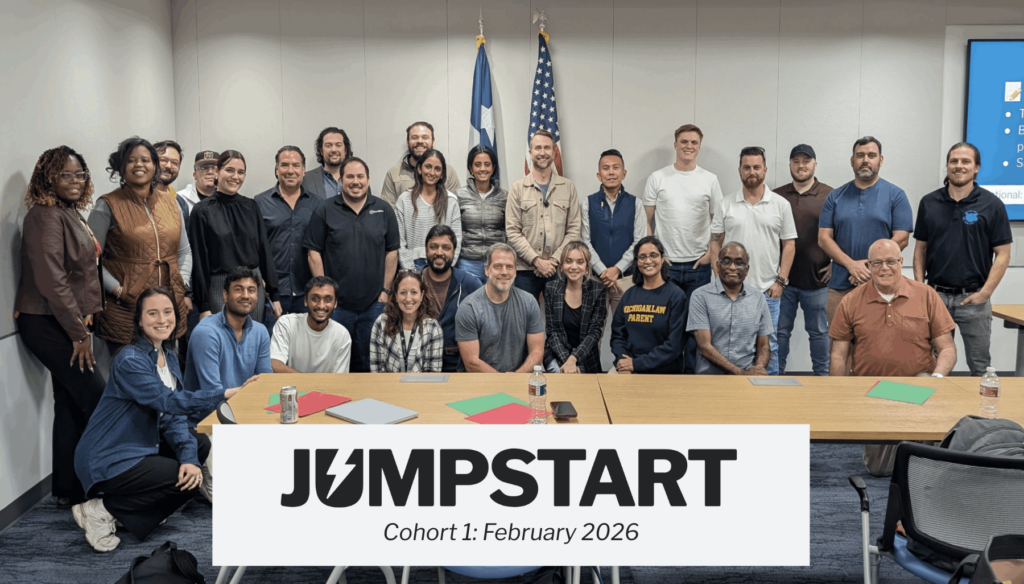
We forced participants to go to coffee shops, order a cup of coffee, and ask for 50% off. If you’ve been an entrepreneur for a long time, that’s easy. If you’re not, it’s terrifying. Oftentimes, in this exercise, there there are people behind you in line. So you’re not only getting rejected, you’re doing it publicly. That was the warm-up.
The real work was a month-long sprint: talking to customers, cold calling, walking into retail shops and asking to talk to the manager. All the stuff you need to do as an entrepreneur that’s a lot easier to think about than to actually do. Plenty of participants walked in somewhere, asked “Who do you use as a POS provider?” and got told to leave. Having a group of people to debrief with after experiences like that is powerful. It makes you feel like you’re not alone.
The real indicator of whether a program like this worked isn’t the survey data. It’s whether the WhatsApp group is still active. Whether people are bragging about their wins. So far, the group is active so I’m feeling good.
The design is intentional. Alumni from the first cohort become peer mentors for the next one. In my world, this is called capacity building—growing the talent in a community so people can support each other. A flywheel.
2. Allocation
Initially when I was writing this, I called this section “execution.” The big argument in the first wave of entrepreneurship was that the idea isn’t important, execution is everything. That’s always been true.
But AI is strange. If you’re curious, playful, and willing to put in the time, it can do a lot of the executing for you.
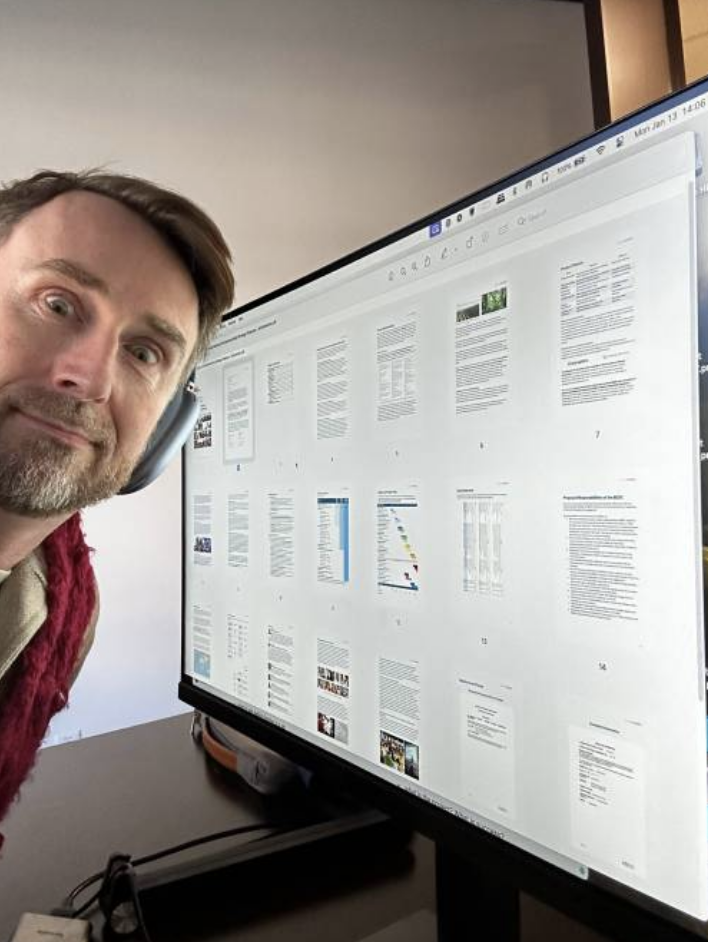
Here’s what I mean. I build startup programs internationally, and part of that work is convincing governments to fund them. To win a deal with, say, the Ministry of Innovation of Portugal, I have to send 50-page proposals full of data, methodology, and a thesis for how we’ll grow entrepreneurs in their community. That used to require four people: a researcher, and others who understood economic development methodologies for international contexts. We’d take a group photo afterward, all of us looking cracked out from the effort.
Now I take a selfie. Same cracked-out look, but it’s just me. AI handles enough of the research, structuring, and drafting that one person can produce what used to take a team. These patterns are showing up everywhere.
Dan Shipper, who runs a company called Every, gave this particular flavor of AI-enabled execution a name: allocation. His argument is that as AI takes over more of the doing, value shifts from execution to decision-making. Your leverage comes not from how fast you can work, but from how well you allocate attention, resources, and judgment.
There’s that famous line: “The hot new programming language of 2025 is English.” I’m not technical. I don’t know how to write code. But I can build now, and AI is what lets me do that.
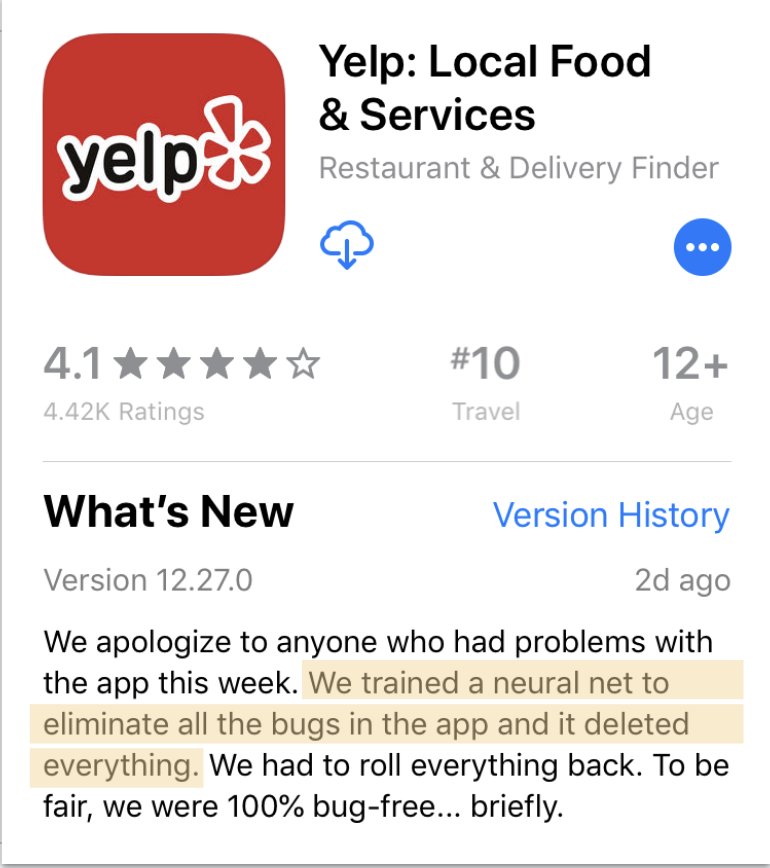
When you skip that step, bad things happen. Yelp, back in the pre-GPT era, was working with neural nets and asked AI to get rid of bugs in their code base. So the AI deleted the entire app. No app, no bugs. The beautiful part is that Yelp—a publicly traded company—admitted this to the world.
3. Discernment
Discernment is a fancy way of saying “evaluating whether or not something is good.” If execution is easier—if we can tell AI to build stuff for us—then AI is going to hand things back to us, and it’s still our job to decide: this is output good or bad?
That sounds simple. It’s actually quite complicated. There are entire branches of philosophy dedicated to evaluating what is good, what is beautiful, what is true.
Think about how roles have shifted. In the first wave of entrepreneurship, you hired a lawyer to draft your incorporation documents and agreements. A 19-year-old in front of ChatGPT is not going to do that. He’s vibe coding legal documents.
There are a lot of things we can be fast and loose with. Legal documents aren’t one of them. If you can’t assess whether what AI gave you is actually good, your company could be in jeopardy. A lawyer exists to reduce risk, especially the kind of risk you don’t even know you’re taking on until it’s too late.
This is where experience is a huge advantage. Good pattern recognition. Jobs we’ve had, mistakes we’ve made. We burned our finger on the stove, and that gave us the ability to judge whether something is good or not. A 19-year-old vibe coding their contracts hasn’t had that yet. That’s going to be interesting to watch. For me to watch. I don’t know if it’ll be fun for them.
The skill is learning to decide: maybe the legal documents are not what we should use AI for. We can use it for a lot of other things. Being able to understand what to use it for, and whether what it gives us is good — that is a super important skill.
What This Means
The first wave of entrepreneurship was a gold rush: exciting, attractive, and it codified this word we didn’t really understand into a real way of learning how to start a business. The U.S. got pretty good at it.
The second wave—the tsunami—is going to push a lot more people into entrepreneurship. And I think if we can focus on these three ideas— community, allocation, and discernment—we’ll be in a much better position as the world continues doing what it’s doing.
Thanks to readers of early drafts: Joe Randel, Kat Koh, Cansafis Foote