
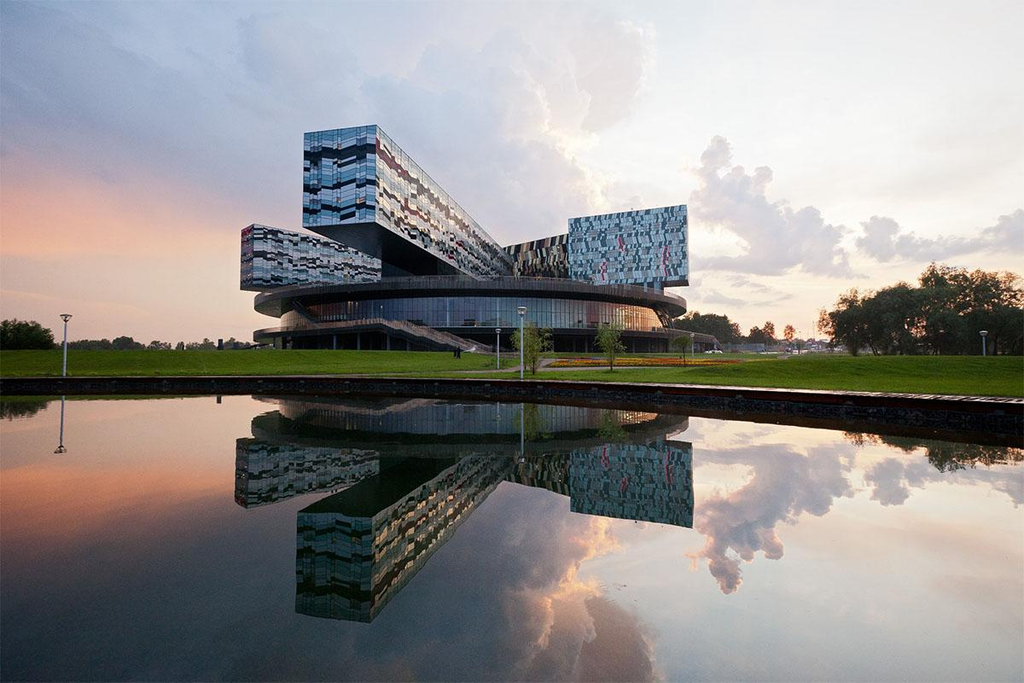
In 2010, Dmitry Medvedev, then Russia’s president, set out to give the country an answer to Silicon Valley. The government picked a thousand-acre plot a twenty-minute drive from the Kremlin, planned to spend four billion dollars, and brought in serious partners: MIT, Siemens, IBM, Intel, Microsoft, Cisco. The point was to grow tech titans of their own, on the scale of a Google, a Facebook, a Netflix.
They called it Skolkovo. They brought in researchers from all over Russia to produce world-changing technology. But the researchers found themselves in a dilemma. As long as a project stayed in the research phase, it stayed promising. Grant funding kept coming. The directors and politicians believed in their potential, and praised the potential breakthroughs that were surely coming.
But when the researchers actually created products and commercialized their work, they put their careers at risk. Once a technology became available to the public, the market would decide whether or not it was a success. A launch that fell flat branded the project a failure, and the researcher might never get another shot.
So people found ways to never move their work beyond the research phase. Why risk a flop that could end the gravy train? A pattern arose where the safest move was for the researchers to kick the can down the road, explaining that breakthrough results were ten or fifteen years away.
This was a tech company version of Schrödinger’s cat, a thought experiment where a cat sealed in a box is both alive and dead until someone looks inside. A technology that never goes to market gets the same protection. It could be brilliant. It could be worthless. It can’t fail, because failure can only happen when the big idea gets launched to the world. So it stays both at once, and as long as it’s in the box, nobody knows.
So Skolkovo came to nothing. It never produced a unicorn or a household name. Then things got worse: a government audit found tens of millions of dollars missing, and investigators raided the offices. Years later Medvedev himself summed up what Russia sends into the world: “we export oil, gas, and, unfortunately, brains.” Silicon Valley spent those same years pulling in the brains of the entire planet. The opposite happened in Moscow.
When I think about my own ideas and projects, I find it useful to remember what happened in Skolkovo.
Launching means letting your idea interact with reality. Someone can use it, ignore it, reject it, or decide it isn’t worth paying for. That puts the idea at risk, but it also puts you at risk. Staying in the research phase puts you in a purgatory: you can keep working on it without having to face the risk of making it real.
Now I make it a habit to ask myself hard questions. Is there a job I’m sleepwalking through but the money is too comfortable? A project that I keep tinkering with instead of sharing it with the world because I’m too scared of rejection? If the answer to any of these is yes, then I’m in a state of mind that I call Skolkovo. I suspect anyone trying to do anything in their life has a few Skolkovos.
Thanks to readers of early drafts: Cansafis Foote, Jack Purdy, Charlie Becker